Space Colonies
In the Universal Century roughly half the human population live in giant space colonies orbiting earth.
These massive structures are grouped into seven clusters referred to as Sides that orbit earth
at the five Lagrange points in the Earth-Moon system.
Gundam's space colonies are directly based on the conceptual Island Three design (commonly referred to as the O'Neill cylinder) proposed by real world physicist Gerard K. O'Neill in his 1976 work "The High Frontier: Human Colonies in Space".
This design simulates gravity by constantly rotating at a speed where the inertial force experienced on the colony's inner surface will approximately equal the force of earth's surface gravity. This allows large scale human space colonization without the adverse effects of long term weightlessness on the human body.
A typical space colony has a diameter of roughly 6.5 kilometres and a length of 30 kilomtres. Throughout each colony are 3 large "windows" through which the colony's mirrors reflect sunlight, forming glass "rivers" splitting the habitable area into three 3.5 km wide landmasses, while also illuminating and heating the colony's interior.
Though much less common than their "open" type counterparts a certain "closed" configuration of space colonies exist where the colony's mirrors are permanently closed to allow the entire surface area of the interor of the colony to be utilized for living space. This can allow space colonies to support significantly higher populations, a notable example of a "closed" type colony is "Zum City" the capital colony of Side 3 (formerly the Principality of Zeon).
An open type space colony
Cross section
Space port
At the far end of the space colony (the side facing away from the sun) is the colony's space port. This section of the colony does not rotate
together with the rest of the colony due to a type of bearing mechanism, this makes it easier for docking ships and shuttles as they don't need to
synchronize their rotation with the colony.
Additionally due to their positioning the space port remains a zero-g area.
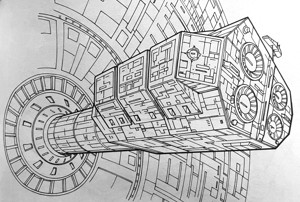
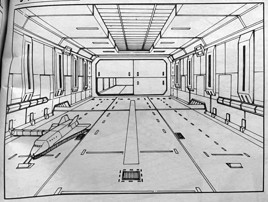
Colony space port
Transportation
Due to their massive internal surface area, various forms of transportation are available to efficiently move around in the space colonies. In the universal century electric cars have largely supplanted their gasoline powered predecessors, and electric automobiles prove to be a common sight even in space. Though there are many different brands of electric cars (commonly referred to as elecars) that offer different models depending on the driver's use case, small two-seaters are by far the most common in the colonies.
The primary limitation of colony based electric cars is their built in speed limit of 50km/h.
This speed limit is in place both because faster speeds would lead to an increase in air pollution,
but perhaps more noticeably, if you were to drive at high speeds in the same direction as the colony's rotation
you would experience yourself become significantly heavier as your speed would add to the inertial force of the colony's artificial gravity.
Conversely, if you were to drive counter to the colony's rotation the car you are driving in would eventually start floating.
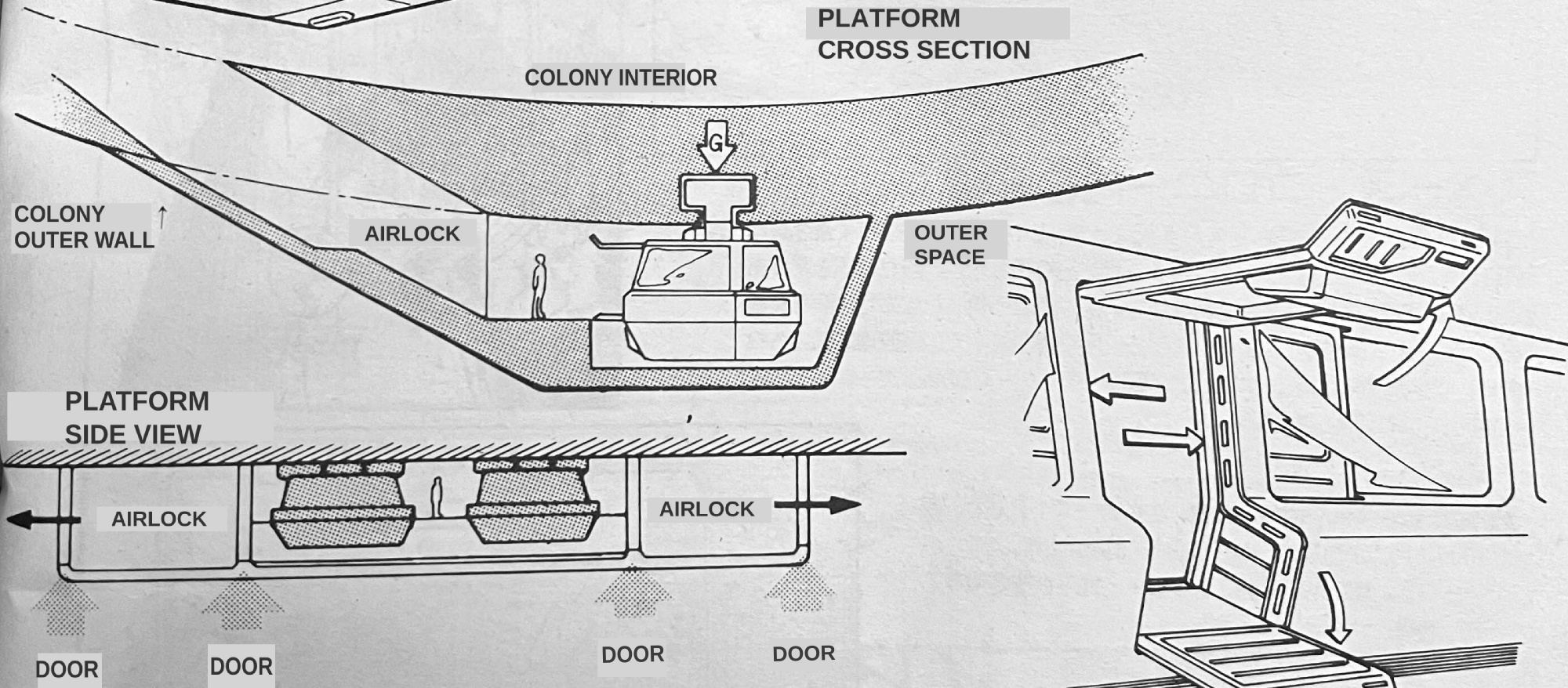
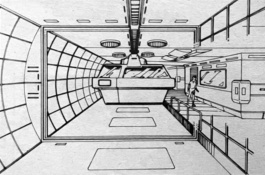
Therefore when traveling lengthwise down the colony other forms of transportation become necessary. For this purpose you have the linear car, a monorail system that travels on the outside of the colony's hull offering both short travel times and a spectacular view of space.
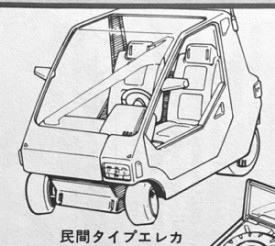
A civillian type electric car
(cute)
A single linear car can hold up to 18 passangers. Due to traveling on the outside of the colony it also has to accomodate all the same
considerations as a space shuttle (pressurized atmosphere, life support systems, etc.), which makes it a deceivingly expensive method
of transportation as far as public transit goes.
Though going underground to take a train may make it seem like a regular subway ride, "down" always means outer space when you're on a colony.
Therefore each linear car station is flanked in both directions by airlocks as seen in the diagram below.